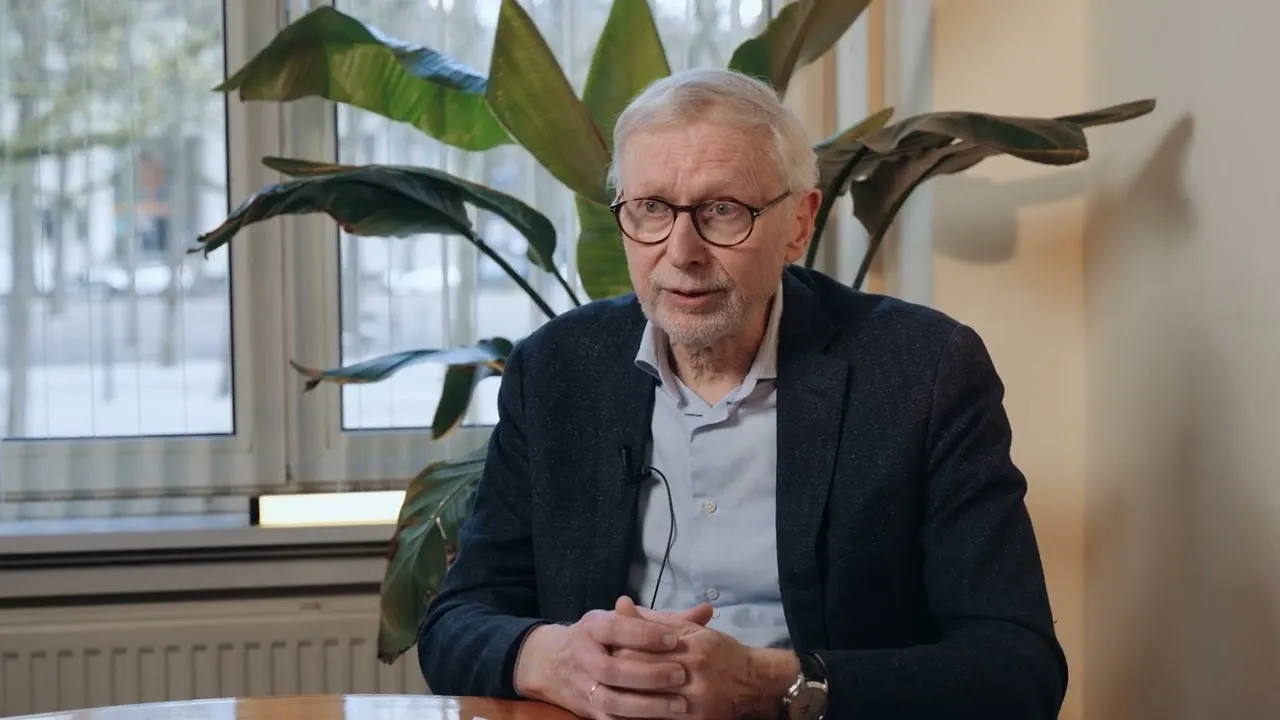
From carbon paper to AI: fifty years of law at a new pace
April 29, 2026

"I used to start by dictating. Then the typist would work it out. Now I dictate a prompt and the AI programme works it out." After nearly fifty years of practising law, Folkert Boonstra says he has come full circle. But in a fundamentally different way. How does one of the longest-serving lawyers in the Netherlands experience the arrival of artificial intelligence in his daily work?
An office above a Chinese restaurant
Boonstra started in 1976 at an office above a Chinese restaurant on Stationsplein in The Hague. Animals hung on racks in front of the windows, the kitchen smell drifted upstairs, and occasionally the office had to close because of cockroaches. With thirteen lawyers it was one of the city's largest firms at the time. He was given a small room in the attic, beneath the rafters, with a skylight where his supervisor's case files sat on the windowsill. The advice he received: "Some files resolve themselves over time. Just let them sit."
Those days are over. Today, Boonstra works alone from his office on Lange Voorhout, surrounded by four screens. At least one of them always has Andri open. Boonstra studied law and philosophy at Erasmus University Rotterdam, has been a member of the bar since 1977, and runs his own litigation practice, AdvoConsult. He spent years leading various law partnerships and served as a municipal lawyer. That combination of decades of experience and daily use of Andri makes his perspective unusual.
From fax to prompt
The history Boonstra has witnessed is one of ever-faster leaps. First the IBM Selectric, replacing the old manual typewriter. Then the fax machine, speeding up communication between firms. Then the dedicated word processor, which eliminated the typing pool. Then the personal computer, the internet, and email.
With each step, not only did the pace change, but so did the expectation. "You used to send a ruling to the client by post. Now the client rings the Council of State themselves and knows about it before you do." Clients became more assertive, response times shorter, and the excuse of "let me think about it" disappeared.
Yet Boonstra considers the arrival of AI a bigger leap than all those earlier changes combined. "This is a far bigger change than the personal computer itself. Back then, typing got faster. Now the texts are already being written."
A complete practice in one system
According to Boonstra, the real difference lies in integration. Where he once pulled case law from loose-leaf binders, then from CD-ROMs, and later via Google, Andri now searches all sources in a single action. "I have it find the relevant case law and articles. It cites them, though I must say you really have to check whether they're correct."
That verification is no formality. Boonstra gives the example of a sub-district court summons in which Andri mistakenly used the text of a regular district court summons, including a passage about court fees that does not apply at sub-district level. "Then I say, that's wrong, take it out. And you get: oh, sorry." He therefore routinely asks for the literal legal reasoning, the hyperlink to the ruling, and checks whether it holds up.
Beyond drafting legal documents, he also uses Andri as a substantive sparring partner. Once a text is finished, he feeds it back in with instructions to check for inaccuracies or contradictions. "A kind of devil's advocate. That gives you a great deal of depth in your knowledge." The system sometimes points out angles he had not considered himself, precisely because all case law is searched.
That workflow reminds him of how it all began. Back then he would dictate his documents and have a typist work them out. Later he had to type everything himself. Now he dictates again, but via a prompt in Andri. "I'm essentially learning to dictate again. The more precise the prompt, the better the answer."
Knowledge remains the prerequisite
Boonstra's enthusiasm has a clear boundary. AI accelerates the work but does not replace professional expertise. He tells of a potential client who came to him with a summons drafted by ChatGPT, complete with case law and literature references. The client had generated the documents himself and only wanted Boonstra to accompany him to the hearing. "I didn't do it. I'd have to verify everything he'd done. And then I'd spend just as much time."
He also notices AI-generated texts arriving in his inbox from other clients. "I can just tell from the emails I receive that it's ChatGPT." He doesn't mind, on the contrary, he sees it as the future. But it confirms his conviction: "If you don't have the subject-matter knowledge, it doesn't work."
A competitive edge for the solo practice
For a solo practice, Boonstra says Andri offers an unprecedented competitive advantage. Without staff or paralegals, he can now conduct research at a level that previously only large firms could deliver. "Competing with large firms is much easier for us now." At the same time, he notes that those large firms are also moving. He already hears that firms are hiring fewer paralegals.
His message to colleagues who have not yet started working with AI is unequivocal. "I think it's impossible to work without AI. Lawyers who don't use it will essentially fall behind within a year."
Curious what Andri could mean for your practice, whether you work as a solicitor or run a solo litigation practice? Try Andri on a matter of your own.
Watch the full interview with Folkert Boonstra on YouTube.
Read also: how boutique firm LAWFOX punches above its weight with Andri, what we learned from our first pilot with Blokziel.